
Mapping Regional Mobility Challenges across ARTEMIS Regions
Mapping Regional Mobility Challenges across ARTEMIS Regions
ARTEMIS has the ambition to support the regional transition of its regions, especially in the topic of mobility, the core identity of the European University.
To do so, ARTEIS has developed a methodology based on a comparative mapping of regional mobility challenges across the eight partner regions of the ARTEMIS European University Alliance. It highlights how mobility is shaped by geography, demographics, infrastructure, governance, and socioeconomic conditions in diverse European contexts — from mountainous and rural areas to coastal regions and medium sized cities.
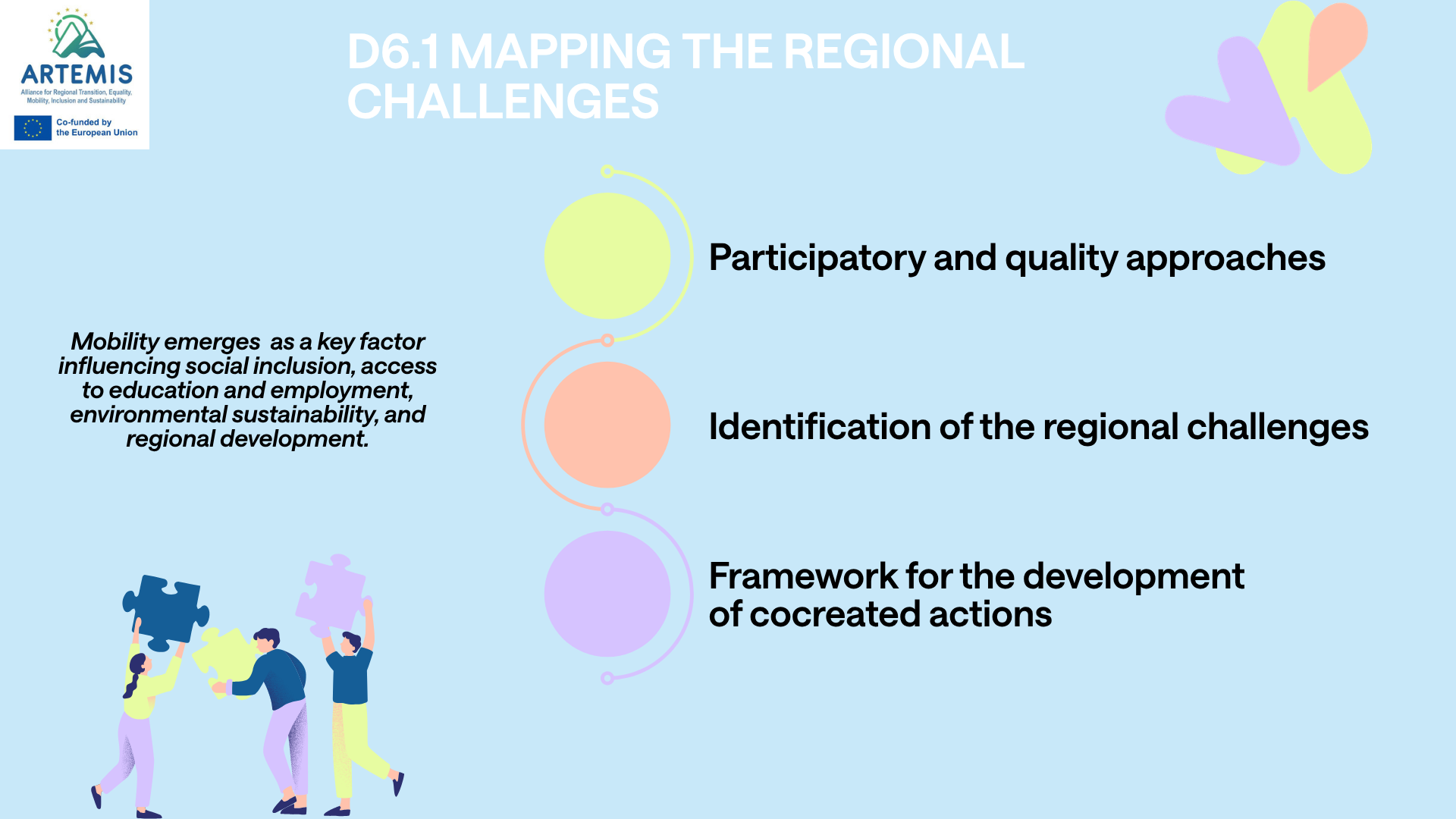
Despite their diversity, all ARTEMIS regions face common structural challenges, including centre–periphery disparities, ageing populations, youth outmigration, strong car dependency, fragmented governance, and uneven access to public transport and essential services. Mobility emerges not only as a transport issue, but as a key factor influencing social inclusion, access to education and employment, environmental sustainability, and regional development.
The mapping exercise is based on participatory and qualitative approaches implemented by each partner university, involving local authorities, civil society, businesses, and citizens. While methodologies were adapted to local contexts, all partners worked within a shared analytical framework covering seven dimensions of mobility: geographical, people, goods, environmental, demographic, migration, and socioeconomic mobility. This common framework enables cross regional comparison and mutual learning.
The findings show that mobility challenges are deeply interconnected with broader regional transitions. Limited public transport, long commuting distances, and accessibility gaps particularly affect students, older adults, migrants, and low income groups. At the same time, regions are experimenting with promising solutions, including Living Labs, digital tools, low emission transport, circular economy approaches, and stronger cooperation between universities, municipalities, and regional stakeholders.
By providing a shared evidence base, this report lays the groundwork for the next phases of WP6, notably the development of Living Labs and the Travelling University initiatives. It confirms the role of universities as key facilitators of dialogue, innovation, and co‑creation, supporting inclusive and sustainable mobility solutions tailored to regional needs.